
Bosch dishwashers use an electronic diagnostic system that continuously monitors the operation of different components. When the system detects a fault or abnormal condition, it may display a specific error code.
An error code helps identify which system may be related to the problem. However, the appearance of a particular code does not necessarily mean that a specific component has failed. The same symptom may have several different causes.
Depending on the Bosch dishwasher model, the meaning of certain error codes and the recommended inspection procedures may vary. Therefore, it is important to refer to the user manual for the exact model number of the appliance.
Bosch's official support information lists E09, E12, E14, E15, E16, E17, E18, E19, E22, E23, E24, and E25 among common dishwasher error codes.
Error code E09 may indicate a fault in the heating system. According to Bosch, E09 is associated with the heating element located within the heat pump.
If the dishwasher does not heat the water, dishes may not be cleaned properly and may remain wet after the program has finished. If E09 appears repeatedly, professional inspection of the heating system and its electrical components is recommended.
Because checking the heating system may require electrical measurements and access to internal components, the appliance should be disconnected from the power supply before disassembly.
Error code E12 may be related to limescale or dirt buildup on the heating element. When this code appears, Bosch recommends cleaning the appliance with a suitable dishwasher cleaner or descaler and checking the water-softening system settings.
In areas with hard water, limescale may accumulate more quickly in the heating system. Proper use of dishwasher salt and correct adjustment of the water hardness setting can help prevent this problem.
Error code E14 may indicate a problem with water entering the dishwasher or with measuring the water flow. According to Bosch's official information, E14 is associated with the flow meter or water-filling system.
When this error appears, the inlet hose, water supply, and proper water intake should be checked. If the problem is related to the internal flow meter or another component, technical diagnosis may be required.
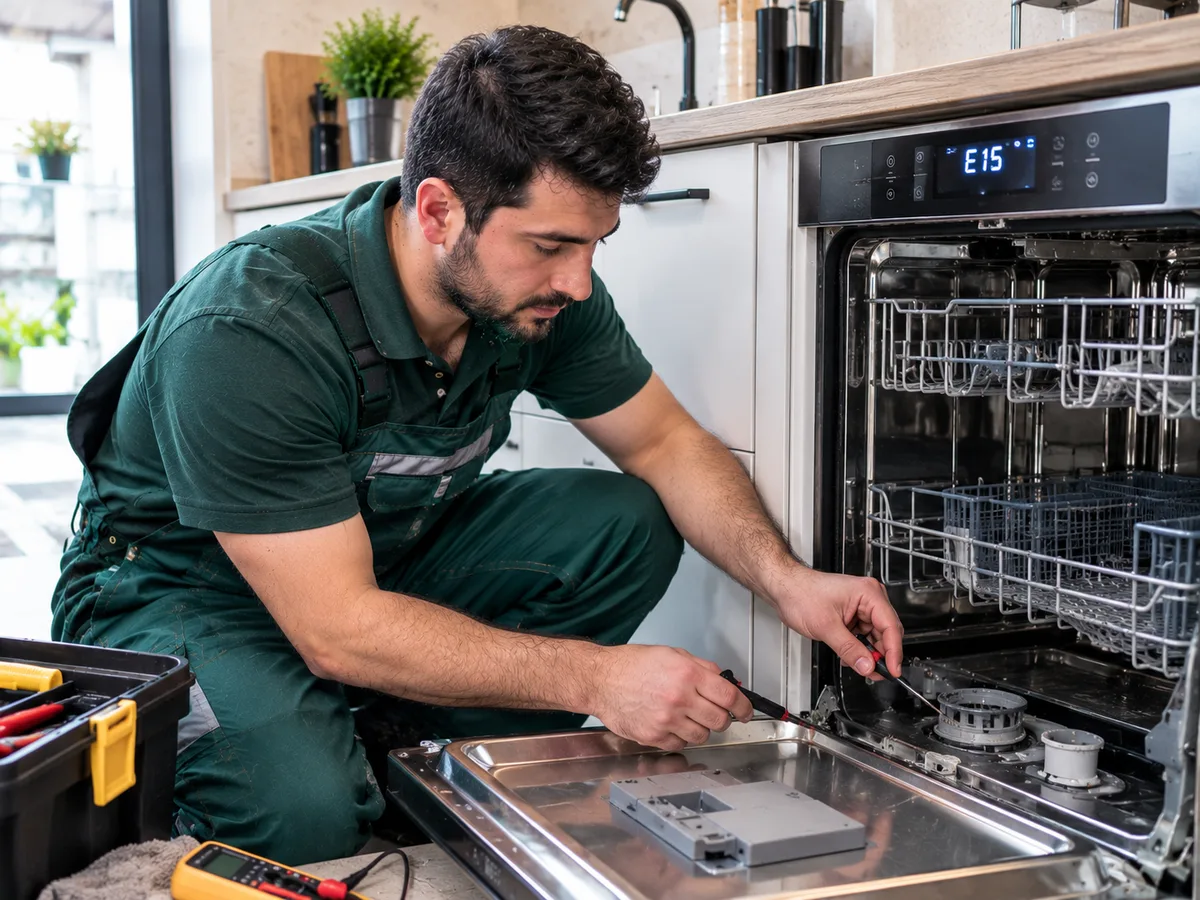
Error code E15 is one of the important leak warnings on Bosch dishwashers. According to Bosch, when water is detected in the lower part of the appliance, the leak protection system may activate and display E15.
If E15 appears, simply resetting the code and restarting the dishwasher is not sufficient. The reason water has entered the lower section of the appliance should be identified.
The leak may originate from a hose, connection, pump system, door area, internal hydraulic component, or another part. The exact source cannot be determined without inspecting the appliance.
For an E15 error, Bosch recommends shutting off the water supply and seeking technical assistance.
Error codes E16 and E17 may indicate problems with water entering the dishwasher or with the filling system. When these codes appear, Bosch recommends checking the inlet hose for kinks or damage.
A pinched or kinked inlet hose may reduce the water flow. It is also important to make sure that the water tap is fully open and that there are no obstructions in the inlet line.
Error code E18 may be related to insufficient water flow or a water level that remains too low inside the appliance. For E18, Bosch recommends checking the inlet hose and making sure that the water supply is turned on.
Bosch's official information states that the water flow should be approximately 10 liters per minute when the water supply is fully open.
If the water tap is open but the dishwasher is not receiving enough water, the inlet hose, inlet filter, water pressure, and filling system should be checked.
Error code E19 may be associated with one of the internal electrical components. Some official Bosch support information associates E19 with the detergent dispenser solenoid circuit, while other regional support information refers to a problem with the dispenser or an internal valve.
With an E19 error, professional diagnosis is safer than attempting to work on the appliance's internal electrical and water systems. Bosch also recommends switching off the appliance and contacting technical service when this error occurs.
Error code E22 is most commonly associated with the filter system. According to Bosch, E22 may indicate that the dishwasher filter is dirty or blocked.
When food particles and dirt accumulate in the filter, water circulation and drainage performance may be reduced. The filter can be removed, cleaned under running water with a soft brush, and then correctly reinstalled.
After cleaning, make sure that the filter is properly seated. An incorrectly installed filter may allow foreign objects to enter the pump system.
Error code E23 may indicate a problem with the drain pump. Bosch associates this code with a blocked, clogged, or faulty drain pump.
If E23 continues to appear, technical diagnosis of the drainage system and pump may be necessary. Since the electrical section of the pump may also need to be checked, removing visible debris alone may not always solve the problem.
Error code E24 is related to water not draining properly from the appliance. Bosch instructions list possible causes such as a kinked or blocked drain hose, a closed siphon connection, or an incorrectly installed drain pump cover.
When E24 appears, first check whether the drain hose is kinked or blocked.
If the dishwasher has recently been installed, it is also important to make sure that the drain and siphon connections have been correctly opened and connected. An obstruction left in the connection may prevent water from draining from the appliance.
If the pump cover is not installed correctly, drainage may also be affected. Make sure that the cover is properly positioned according to the instructions for the specific model.
Error code E25 may be related to the drain pump being blocked by a foreign object or the pump cover not being installed correctly. In this situation, Bosch recommends cleaning the pump and correctly securing the cover.
Care should be taken during cleaning because broken glass or other sharp objects may be present around the pump. This risk is also specifically mentioned in Bosch's official instructions.
Food particles, pieces of glass, and other foreign objects inside the pump may prevent the impeller from rotating. After cleaning, check whether the impeller can move freely.
A water tap symbol may also appear on the Bosch dishwasher display together with an error code. This warning may indicate that the water supply system should be checked. Bosch also lists the water tap symbol as a separate fault indicator.
In this situation, check the water tap, inlet hose, possible blockage of the inlet filter, and whether the appliance is receiving sufficient water flow.
Repeatedly switching a Bosch dishwasher off and on when an error code appears does not resolve the underlying fault. With some electronic errors, disconnecting and reconnecting the power may provide temporary relief, but if the code returns, the cause should be identified.
Do not attempt to bypass safety systems or disable sensors simply to clear an error code. These systems are designed to protect the appliance against water leaks, heating problems, and other potentially hazardous conditions.
During diagnosis, it is useful to observe at which stage of the program the error code appears. If the code occurs during water intake, washing, water heating, or drainage, this information can help identify the source of the problem.
For example, if water remains inside the dishwasher at the end of the program and E24 or E25 appears, the drainage system becomes one of the main areas to inspect. With E22, particular attention should be paid to the condition of the filter.
If a leak-protection error such as E15 appears, continued use of the dishwasher is not recommended until the cause of water accumulating in the lower section of the appliance has been identified.
If a heating-system error such as E09 repeatedly appears, electrical measurements of internal components and inspection of the heating system may be required.
Knowing the model number of the Bosch dishwasher is useful for correctly interpreting an error code. Construction and diagnostic procedures may differ between model series.
When an error code appears, it is advisable to write it down or take a photo of the display. Even if the code later disappears, this information can help a dishwasher repair technician with diagnosis.
Simple checks that a user can perform include making sure the water tap is open, checking that the hoses are not kinked, inspecting the cleanliness of the filter, and checking the condition of the drain line.
Inspecting internal electrical components, the heater, electronic control board, sensors, and the pump's electrical circuit may require technical knowledge and measuring equipment.
Because a dishwasher uses both water and electricity, the appliance should be disconnected from the power supply before any work is carried out on internal components.
If E09, E15, E19, E23, or other technical error codes continue to appear on a Bosch dishwasher, or if the appliance leaks, does not heat the water, or cannot complete a program, it is advisable to contact a professional dishwasher repair technician. Proper diagnosis can help identify the actual cause of the error code and prevent unnecessary replacement of parts.