
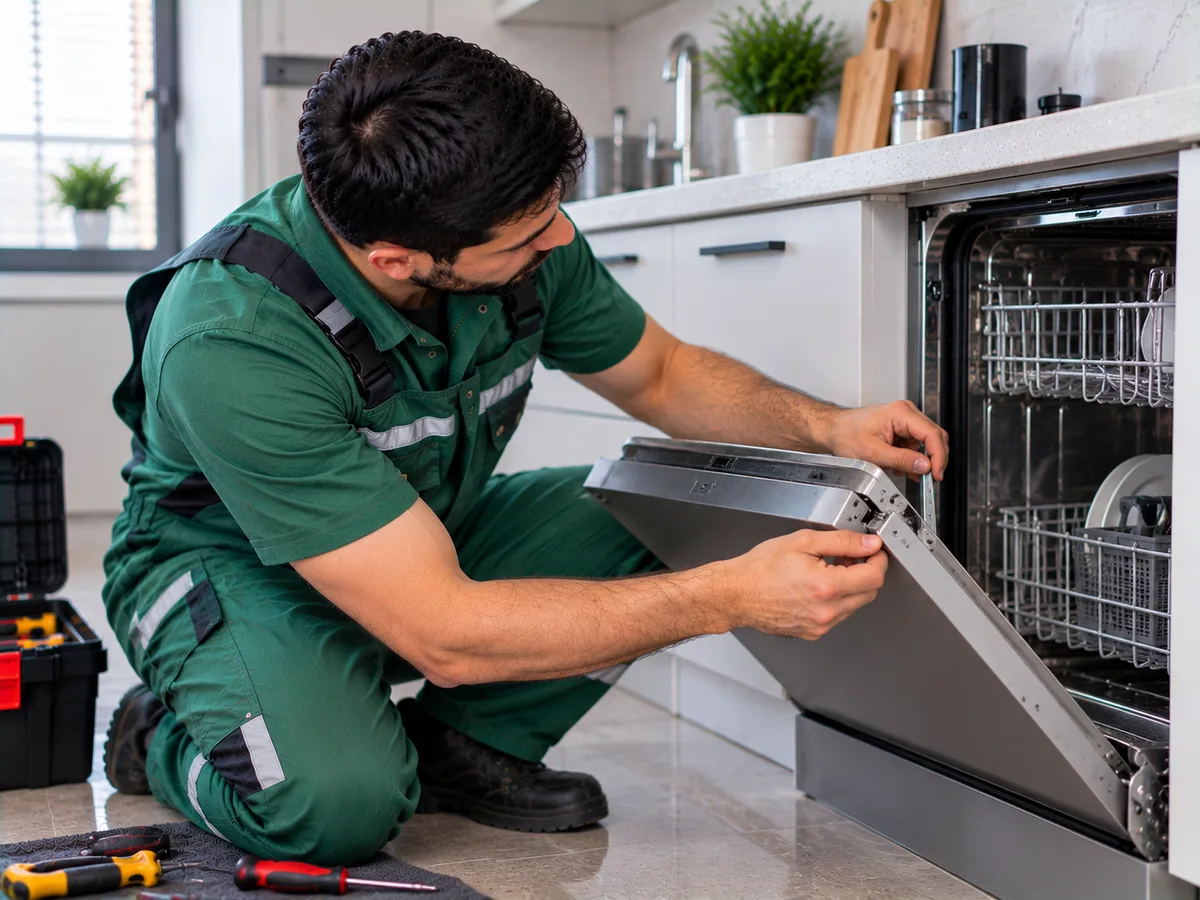
If the dishwasher door does not close, it can prevent both normal use of the appliance and the washing program from starting. In many dishwasher models, the safety system will not start the wash cycle until it confirms that the door is fully closed and locked.
If the door does not close, first check whether the baskets, dishes, or cutlery basket are obstructing its movement. A large plate, pan handle, or incorrectly positioned basket can prevent the door from closing completely.
The position of the upper and lower basket rails should also be checked. If the baskets have come off the rails or have not been pushed fully inside, they may obstruct the door when it is being closed.
One of the most common reasons a dishwasher door does not close is a faulty door lock. The locking mechanism keeps the door closed and at the same time sends a signal to the control system confirming that the door is locked.
If the lock mechanism is worn, broken, or jammed, the door may fail to lock even when it appears to be in the correct position. In this case, the door may look closed but open again with only a light touch.
Some models have a microswitch or sensor inside the door lock. This component confirms through the electronic control board that the door is closed. If the microswitch fails, the program may not start even though the door is mechanically closed.
The metal or plastic strike located opposite the lock should also be checked. If this part is bent, loose, or shifted out of position, the lock may not engage with it correctly.
If more force than usual is required to close the door, the lock and strike may be out of adjustment. Forcing the door closed can cause further damage to the mechanism.
The hinges help the dishwasher door move correctly and remain aligned with the appliance body. If a hinge is bent or its mounting points become loose, the door may tilt to one side and fail to align properly with the lock.
If one side of the door appears lower than the other, there may be a problem with the hinge or hinge connections. In this situation, the door may rub against the appliance body and fail to reach the locking position.
Dishwasher doors also use a spring and cable mechanism. This system balances the weight of the door and makes opening and closing easier.
If one of the springs or cables breaks, the door may become excessively heavy, drop quickly, or move unevenly. In some cases, this can also prevent the door from closing properly.
If the door suddenly falls when opened or pulls to one side while closing, the spring and cable system should be checked. When replacing these parts, it is important to maintain equal tension on both sides of the door.
The door seal can also affect closing. A new seal or one that has come out of its groove may prevent the door from seating completely.
If the seal is folded, hardened, or displaced from its channel, it can create additional resistance when the door is closed. The seal should be positioned correctly around the entire perimeter.
After a new door seal is installed, it may feel slightly stiff during the first few days. However, if the door is extremely difficult to close, it should be checked whether the seal is correct for the model and properly fitted.
Food residue, detergent, and dirt accumulated around the lower or side areas of the door can also prevent proper closing. It is important to keep the door frame and the area around the seal clean.
Incorrect leveling of the dishwasher can also cause door problems. If the appliance is leaning forward, backward, or to one side, the alignment between the door and lock may change.
If the dishwasher is installed inside kitchen cabinetry, correct adjustment of the front feet and overall level is especially important. If the appliance body is uneven, the door may not remain parallel with the frame.
On built-in dishwashers, incorrect installation of the furniture front panel can change the weight and balance of the door. A misaligned or excessively heavy panel can place additional strain on the hinges and spring system.
If the door rubs against the cabinet front or side panels, this may also prevent it from closing properly. During installation, the appliance should be correctly aligned and centered inside the cabinet.
If the door stops closing immediately after a new dishwasher is installed, one of the main causes may be incorrect installation adjustment. The height of the feet, appliance level, and mounting points to the cabinetry should be checked again.
If the door previously closed normally and the problem appeared suddenly, a faulty lock, hinge, spring, or mechanical obstruction is more likely.
If no clicking sound is heard when closing the door, the locking mechanism may not be engaging. In many properly working models, a mechanical click can be felt or heard when the door is fully closed and the lock engages.
If the door clicks but the program does not start, the door sensor, microswitch, wiring, or control board should be checked. If the electronic system does not recognize the door as closed, the appliance may refuse to operate for safety reasons.
Loose or damaged wires leading to the door lock can cause the same symptom. The appliance should be disconnected from the power supply before these parts are checked.
Some models may display an error code related to the door. The error code can help identify whether the problem is associated with the lock, sensor, or control system.
It is not recommended to repeatedly force the door closed. Excessive force can damage the lock, hinges, plastic components, and even the inner door panel.
As an initial check, the user can inspect whether the dishes are positioned correctly, whether the baskets are pushed fully inside, the condition of the door seal, and whether there are any visible obstructions.
It is also possible to check whether the dishwasher is level. If the appliance appears tilted, adjusting the feet may help solve the problem.
Disassembling the lock mechanism, hinges, and spring-cable system requires more technical knowledge. Because the door mechanism contains springs under tension, incorrect intervention can be dangerous.
When replacing the door lock, it is important to choose a spare part that matches the specific model. Locks that look similar may have different electrical connectors and mechanical dimensions.
When replacing a hinge or spring, both sides of the door should remain properly balanced. Replacing a faulty component on only one side can sometimes cause the door to operate unevenly.
If the door seal is replaced, it should be fully seated in its channel and installed without twisting. An incorrectly fitted seal can prevent the door from closing and may also cause water leakage during washing.
If the dishwasher door does not close, does not lock, or the program does not start even when the door appears closed, it is recommended to contact a professional dishwasher repair technician. The technician can inspect the door lock, microswitch, hinges, spring and cable system, door seal, wiring, and appliance adjustment to determine the exact cause of the problem.