
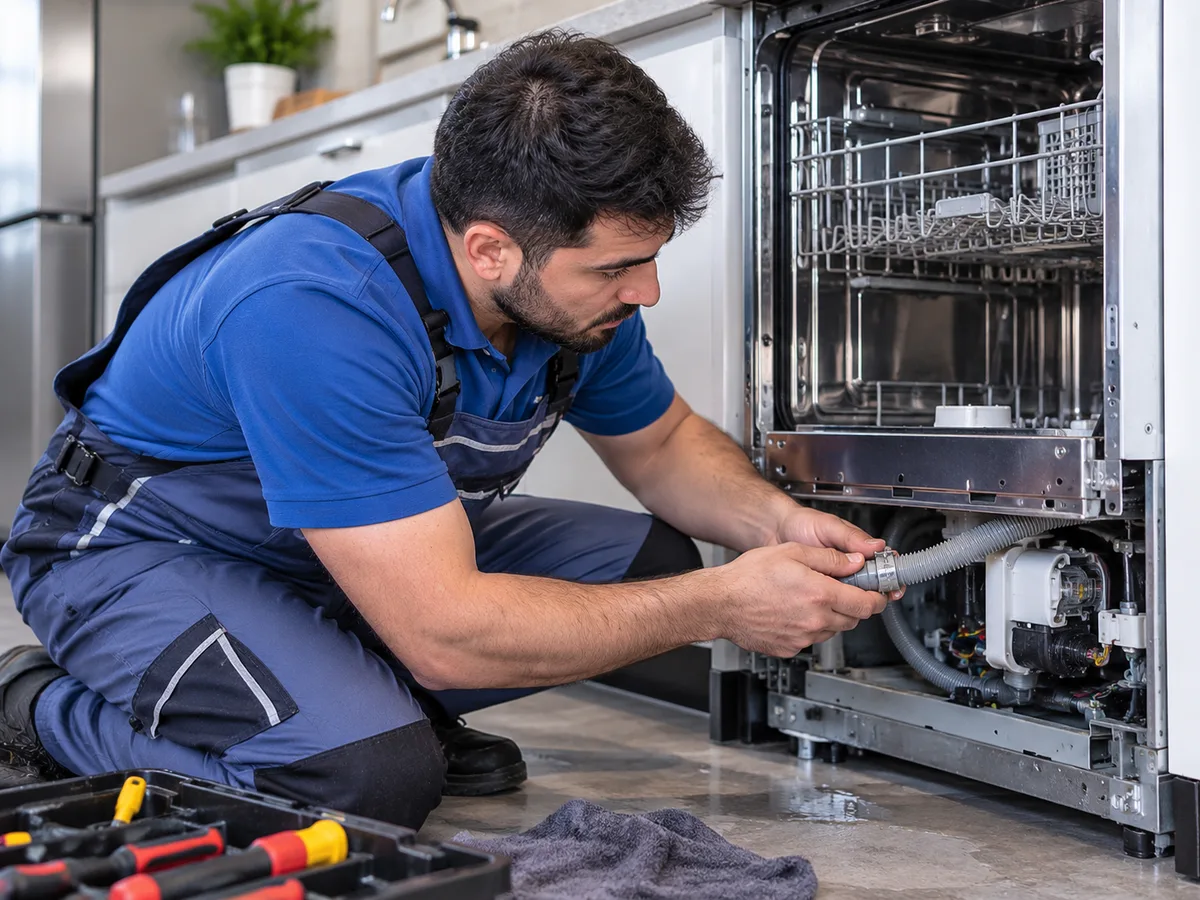
Water leaking from a dishwasher is a fault that can damage not only the appliance itself but also kitchen cabinets and flooring. When a leak is detected, it is important to identify its source.
One of the first components to check is the water inlet hose. If the hose is cracked, punctured, or loose at a connection point, water may leak behind or underneath the appliance.
The points where the inlet hose connects to the water supply and the dishwasher should also be checked. If a gasket is worn or a connection is not properly tightened, water may begin to drip.
Another possible cause is the drain hose. A cracked or damaged hose, or a loose connection between the hose and pump, can cause water to leak during a wash cycle.
If water is appearing underneath the dishwasher, the drain pump and the connections around it should also be inspected. A problem with the pump housing or seal can cause water to collect at the bottom of the appliance.
In some models, leaks from the circulation pump or the connected water channels can also cause water to accumulate underneath the dishwasher.
The door seal is another common cause of dishwasher leaks. If the seal is worn, torn, or covered with dirt, the door may no longer close tightly enough to prevent water from escaping.
A door that does not close correctly or improperly adjusted hinges may also allow water to leak from the front of the dishwasher during operation.
The internal hoses, clamps, and connections inside a dishwasher can become loose or damaged over time. Identifying these types of leaks may require inspection of the appliance's internal components.
Excessive foam can sometimes create a problem that appears to be a water leak. Using detergent that is not suitable for dishwashers can produce too much foam and cause water to escape around the door.
Incorrect leveling of the dishwasher may also cause water to collect near the door and contribute to leakage.
In some modern dishwashers, a leak protection system is activated when water is detected in the bottom section of the appliance. When this happens, the dishwasher may stop the program, display an error code, or run the drain pump continuously.
The user can first disconnect the appliance from the power supply and turn off the water supply. The inlet and drain hoses can then be checked for visible damage, along with the condition of the door seal.
If water has collected underneath the dishwasher, the appliance should not continue to be used. If water reaches electrical components, it may cause additional faults and create an electrical hazard.
If the leak is not coming from a hose or visible connection, a technical inspection of the pump, internal pipes, seals, and other water connections may be required.
A professional dishwasher technician can inspect the hoses, drain and circulation pumps, door seal, clamps, and internal connections to accurately identify the source of the leak.