
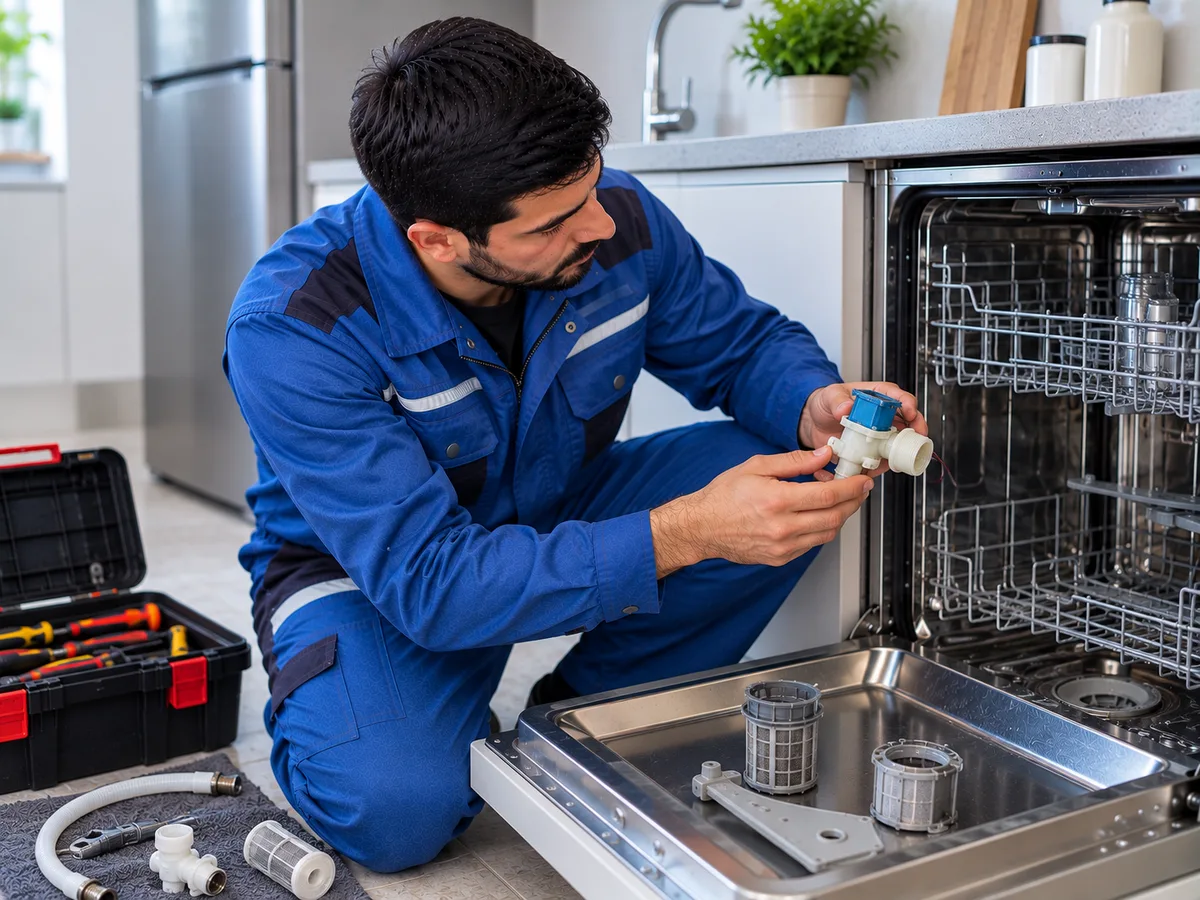
If a dishwasher does not fill with water after the program starts, the washing cycle cannot begin. The appliance may turn on, the indicators may light up, and a program may be selected, but without water entering the washing chamber, the cycle will not proceed. The cause may range from a simple water supply issue to a faulty inlet valve or electronic control module.
The first thing to check is the water supply line connected to the dishwasher. A closed or partially opened water tap may prevent the appliance from receiving enough water. This is especially worth checking if the dishwasher has not been used for a long time or if plumbing work was recently carried out.
It is also important to make sure that water is available in the house or premises. If the water supply has been temporarily interrupted or the pressure in the line is too low, the dishwasher may fail to start the program and may not fill with water. Checking whether water flows normally from other taps can help determine whether the problem is with the appliance or the main water supply.
The dishwasher inlet hose should also be inspected carefully. A bent, pinched, or compressed hose behind furniture can restrict the flow of water into the appliance. If the dishwasher was recently moved or installed, make sure the hose is positioned correctly.
A small mesh filter may be located where the inlet hose connects to the dishwasher or the water supply. Over time, dirt, rust, sand, and other small particles in the water can build up in the filter and reduce water flow. If the filter becomes heavily clogged, the dishwasher may receive very little water or none at all.
Before cleaning the filter, it is important to disconnect the dishwasher from the power supply and close the water tap. After removing the filter, accumulated dirt and deposits can be cleaned away. The procedure should be carried out carefully to avoid damaging the filter or the water inlet connection.
One of the main components responsible for controlling water intake is the inlet valve. When the program starts, the control system sends a signal to the valve, causing it to open and allow water into the appliance. If the inlet valve is faulty, it may fail to open even when it receives an electrical signal, and the dishwasher will not fill with water.
The inlet valve can also become mechanically blocked. Dirt and mineral deposits from the water supply may build up inside the valve and prevent it from opening and closing properly. In some cases, the electrical part of the valve may still work, but a mechanical problem can restrict the amount of water passing through.
In dishwashers equipped with an AquaStop system, a failure to fill with water may also be related to the safety system. If a fault is detected in the AquaStop hose or another part of the system, the appliance may automatically stop the water supply. This function is designed to reduce the risk of water leaks.
If water collects in the bottom section of the dishwasher, the leak protection system may be activated. In this situation, the appliance may block the intake of new water, and in some models only the drain pump may continue to operate. The dishwasher should then be checked for leaks underneath or inside the appliance.
A door that does not close completely can also prevent some dishwasher models from starting the water intake process. The door lock or door sensor confirms to the control system that the door is securely closed. If the lock mechanism is faulty or the door does not fit properly, the control module may prevent water intake for safety reasons.
A faulty pressure switch or other water level sensor can also affect water intake. If the sensor incorrectly detects that there is already enough water in the system, the control module may not open the inlet valve. A blocked sensor hose or an electrical connection problem can cause a similar issue.
In some cases, the dishwasher attempts to fill with water, but only a slight humming or clicking sound is heard. This may indicate that the inlet valve is trying to operate but water is not entering the appliance. In such a situation, the water tap, water pressure, inlet hose, filter, and inlet valve should be checked together.
If an error code appears on the dishwasher display, it may help identify the water inlet problem more accurately. Error code meanings vary by manufacturer and model, so troubleshooting should be carried out according to the appliance manual. The same code may indicate different faults on different models.
A fault in the electronic control module may also prevent a signal from being sent to the inlet valve. If the valve, water supply line, and other mechanical components are working properly but the dishwasher still does not fill with water, the control board, wiring, and connectors may need to be checked.
Testing the electrical components of the water inlet system requires technical knowledge. Measuring the resistance of the inlet valve, checking whether voltage is being supplied from the control board, and diagnosing sensors should be performed with appropriate measuring equipment. Uncontrolled work on an appliance connected to the power supply can be dangerous.
As a basic check, make sure the water tap is open, the inlet hose is not bent, the water pressure is normal, and the filter is not clogged. If the dishwasher still does not fill with water after these checks, the problem may be related to the inlet valve, AquaStop system, door lock, water level sensor, or control module.
If the dishwasher does not fill with water and the cause cannot be identified through basic checks, it is recommended to contact a professional dishwasher technician. A technician can inspect the water supply line, hose and filter, inlet valve, AquaStop system, door lock, water level sensors, electrical connections, and control module to determine the exact cause of the fault.