
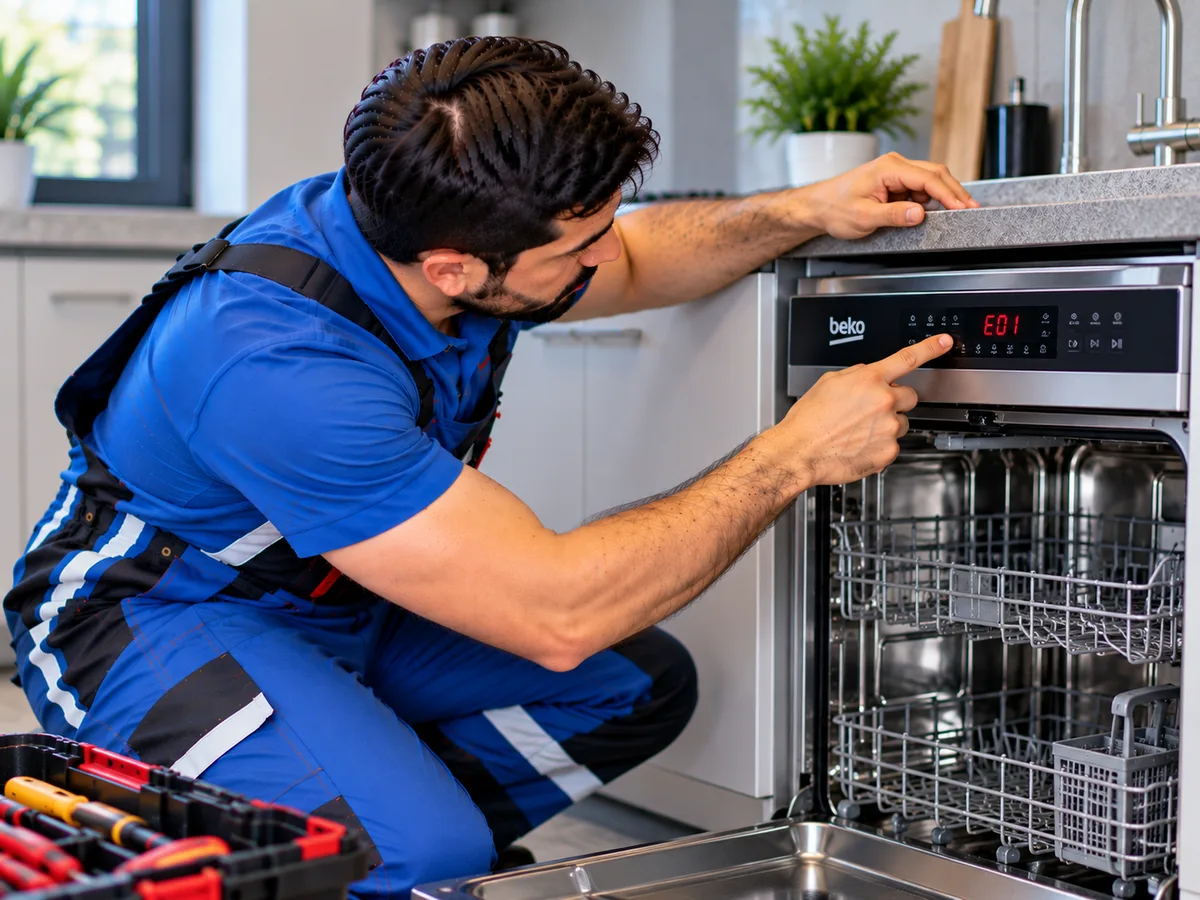
An error code appearing on the display of a Beko dishwasher may indicate that the appliance has detected a fault or abnormal operation in a particular system. Although an error code can help identify which part of the appliance may have a problem, replacing components based only on the code without further diagnosis is not recommended.
Beko dishwasher error codes may vary depending on the model and series. The same fault may be represented by different codes on different models. Therefore, the exact meaning of the code shown on the display should be checked in the user manual or service documentation for the specific appliance model.
One of the common dishwasher problems is a water intake error. In this case, the water supply valve, inlet hose, inlet filter, water pressure, and water inlet valve should be checked.
If the water supply valve is closed, the hose is kinked, or the inlet filter is blocked, the dishwasher may not receive enough water. If the electronic control system does not detect the required water level within a certain period, it may display an error.
Another common problem is failure to drain water. If water remains inside the dishwasher after the program has finished, the drain filter, drain pump, and drain hose should be checked.
Food particles and other debris accumulated in the filter can restrict the flow of water into the drainage system. A kinked or blocked drain hose can also prevent water from being properly removed from the dishwasher.
A foreign object trapped in the drain pump impeller can restrict the operation of the pump. If the pump receives electrical power but cannot drain the water, the pump itself may also be faulty.
A Beko dishwasher error code may also be related to the water heating system. If the dishwasher cannot heat the water to the required temperature, the heating element, temperature sensor, wiring, and electronic control system should be inspected.
An open circuit or failure of the heating element can prevent the water from heating. However, if the heater does not operate, this does not always mean that the heating element itself is faulty.
The temperature sensor measures the water temperature and sends this information to the electronic control board. If the sensor sends incorrect readings, the dishwasher may be unable to control the water temperature properly and may stop the program with an error.
Some faults are related to water level detection. Problems with the pressure sensor, water level sensor, connected tubes, or electrical connections can prevent the dishwasher from correctly determining the amount of water entering the appliance.
If the dishwasher takes in too much water, the problem may also be related to the sensor, water inlet valve, or electronic control system. If the inlet valve becomes stuck in the open position, more water than necessary may enter the dishwasher.
Water leak detection can activate the safety system in some Beko dishwasher models. If water collects in the bottom section of the appliance, the protection system may stop the water supply and activate the drain pump.
In this situation, simply removing the water from the bottom of the dishwasher is not enough. It is necessary to determine whether the leak is coming from the door seal, hose, pump, connection point, or another internal component.
A problem with the circulation pump can also cause the washing cycle to stop and an error to appear. The circulation pump sends water under pressure to the spray arms, allowing the dishes to be washed properly.
If the pump operates poorly, the dishwasher may still fill and drain normally, but the dishes may not be cleaned properly because there is insufficient pressure at the spray arms.
Electrical connection problems can also cause various error codes. A loose connector, oxidized contact, damaged wire, or short circuit can interrupt communication between the sensors and the electronic control board.
If the electronic control board is faulty, the dishwasher may fail to start a program, stop before completing the cycle, control components incorrectly, or display an error code.
However, before replacing the electronic control board, the connected sensors, pumps, heating element, valves, and wiring should be inspected. A short circuit in another component can also affect the operation of the control board.
In some cases, an error may appear because of a temporary voltage fluctuation in the electrical supply or a temporary program malfunction. If the manufacturer provides a safe restart procedure for the appliance, it can be performed according to the instructions.
If the same error code appears again, repeatedly clearing the error and restarting the dishwasher will not solve the underlying problem. The actual cause of the fault should be identified.
If the error code appears together with water remaining inside the dishwasher, a water leak, burning smell, tripping circuit breaker, or unusual noises, continuing to use the appliance is not recommended.
The model number of a Beko dishwasher is usually shown on the appliance's information label. For an accurate explanation of an error code, it is best to check the code together with the exact model number.
A professional dishwasher repair technician can use the error code as part of the diagnosis and systematically inspect the water inlet system, drain pump, filters, heating element, temperature and water level sensors, circulation pump, wiring, and electronic control board.
Proper diagnosis helps determine which fault is causing the error code and prevents unnecessary replacement of components that are still functioning correctly.