
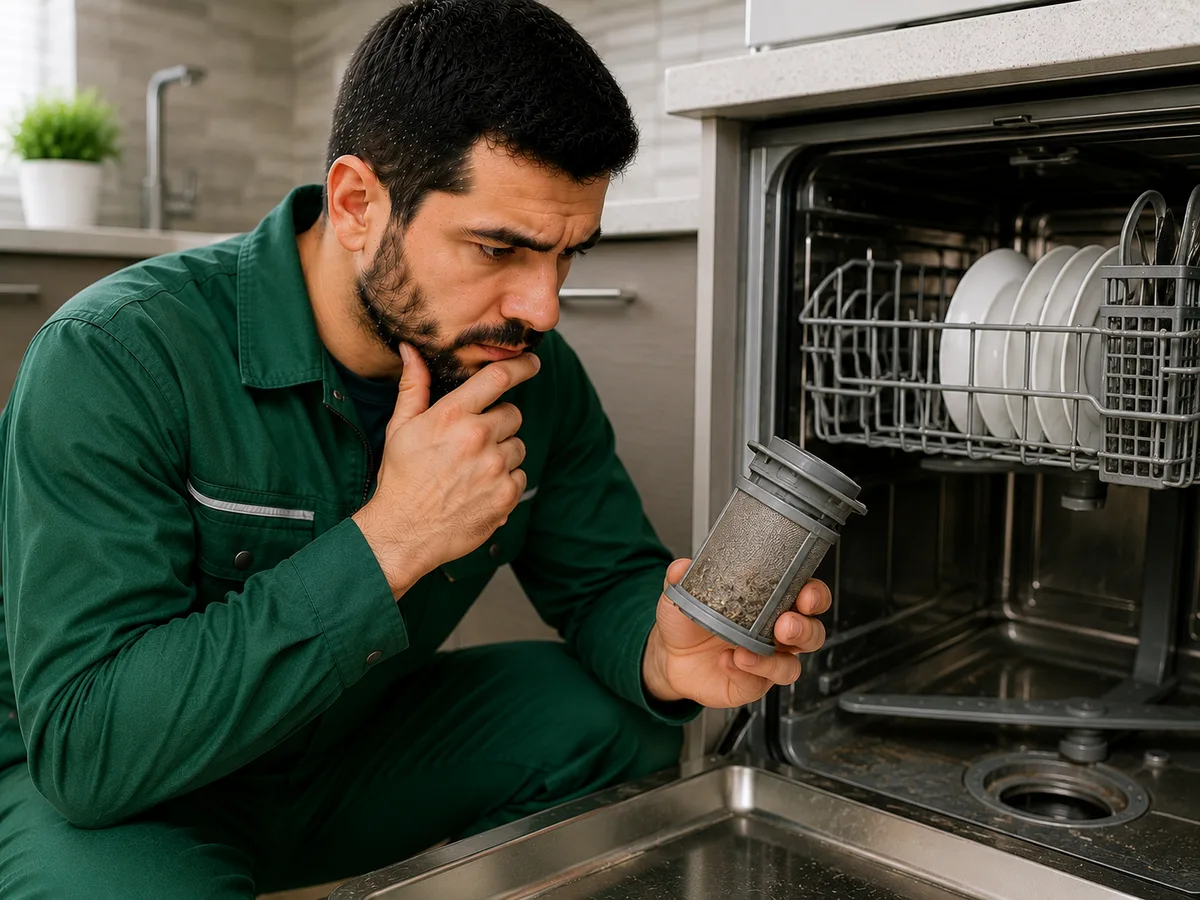
A clogged dishwasher filter can directly affect washing performance and normal water circulation inside the appliance. During the wash cycle, food particles, grease, and other debris collect in the filter. If the filter is not cleaned regularly, water flow can become restricted and various problems may develop over time.
One of the main signs of a clogged dishwasher filter is poor cleaning performance. If the program finishes normally but food residue or a greasy film remains on plates, glasses, and other dishes, a dirty filter may be one of the possible causes.
When the filter is clogged, water circulation inside the dishwasher may become weaker. During operation, water passes through the filter and is redirected back into the washing system. If the filter is heavily soiled, water movement can be restricted, causing the spray arms to deliver water with insufficient pressure.
Water remaining at the bottom of the dishwasher after the program ends can also be a sign of a clogged filter. If a noticeable amount of dirty water remains in the lower part of the appliance, the filter may be preventing water from flowing properly into the drainage system. However, this problem may also be related to the drain pump or drain hose, so the entire drainage system should be checked.
Slower drainage than usual may also indicate that the filter is dirty. If the dishwasher takes a long time to drain water at the end of the program or the drainage stage lasts longer than before, food particles accumulated in the filter may be restricting water flow.
An unpleasant smell coming from the appliance is one of the most common signs of a clogged filter. Food particles and grease trapped in the filter can begin to decompose over time and produce a bad odor. If an unpleasant smell is regularly noticeable when the dishwasher door is opened, the filter should be one of the first parts to check.
Visible food residue around the filter is also a clear sign of contamination. If grease, bone fragments, pieces of labels, or other debris can be seen around the filter after removing the lower basket, the filter needs to be cleaned.
Small dirt particles appearing on the dishes again after washing can also be related to poor filtration. If the filter cannot properly trap debris, these particles may re-enter the water during the wash cycle and settle back onto the dishes.
Cloudiness on glasses or small particles on dishes may also sometimes be related to inadequate filtration. However, detergent, dishwasher salt, and rinse aid can also affect the washing result, so this symptom alone does not necessarily indicate a filter problem.
A clogged dishwasher filter can also affect the operation of the spray arms. When water circulation is reduced, the spray arms may not operate with sufficient pressure. As a result, dishes placed in the upper or lower basket may remain dirtier than usual.
Clogged spray arm holes can produce similar symptoms. Therefore, when washing performance decreases, both the filter and the spray arm holes should be checked. Small food particles and limescale can block these openings and prevent water from being distributed properly.
If the filter is severely clogged, the dishwasher may also make unusual noises during operation. When water circulation is restricted and the pump works under greater load, unusual humming or water movement sounds may be heard. However, unusual noise can also be a sign of a problem with the pump itself.
A dishwasher program stopping halfway can also occur in cases of severe clogging. If the appliance cannot circulate or drain water properly, some models may stop the program and display an error code.
An error code related to the drainage system can also be a reason to check the filter. Error codes vary by brand and model, so the meaning of the specific code should be checked in the appliance manual. The drain pump and drain hose should also be considered together with the filter.
How quickly the filter becomes dirty depends on how the dishwasher is used. If dishes are loaded with large amounts of food residue still on them, the filter will clog more quickly. Removing large food particles before loading the dishwasher can help the filter remain effective for longer.
However, it is not necessary to fully wash the dishes by hand before placing them in the dishwasher. The main goal is to remove bones, large food pieces, napkins, paper, labels, and other large waste that could enter the appliance.
Regular cleaning of the filter is important for the normal operation of the dishwasher. Depending on how often the appliance is used and how dirty the dishes are, the filter should be removed periodically, inspected, and cleaned of food residue.
Before cleaning the filter, the dishwasher should be disconnected from the power supply. After removing the filter, large debris can be removed and the filter can be rinsed under running water. Since filter designs differ by model, removal and reinstallation should be carried out according to the manufacturer’s instructions.
It is not recommended to clean the filter with hard metal tools. Damaging the filter mesh may prevent it from trapping dirt particles properly. A damaged filter can later allow food debris to reach the pump and other internal components.
After cleaning, the filter must be installed correctly. If it is not fully secured or is positioned incorrectly, food particles may bypass the filter and enter the pump system, potentially causing more serious problems.
If the filter is clean but the dishwasher still does not drain water, smells unpleasant, or performs poorly, the problem may be located elsewhere. The drain pump, drain hose, circulation pump, spray arms, and drain connection should also be checked.
If glass fragments, hard bone pieces, or other sharp objects are visible around the filter area, they should be removed very carefully. Sharp objects can cause injury and may also damage internal pump components.
Pay attention to the following signs: if dirty water constantly remains at the bottom of the dishwasher, the filter quickly becomes clogged again, strong or unusual noises occur during drainage, the program stops halfway, an error code appears, or the problem continues after the filter has been cleaned, professional inspection of the drainage and circulation systems is recommended.
If you suspect that the dishwasher filter is clogged and the problem continues after cleaning, it is recommended to contact a professional dishwasher technician. The technician can inspect the filter system, drain pump, drain hose, circulation pump, spray arms, and drain connection to determine the exact cause of the problem. You should be informed about the required work and cost before the repair begins.