
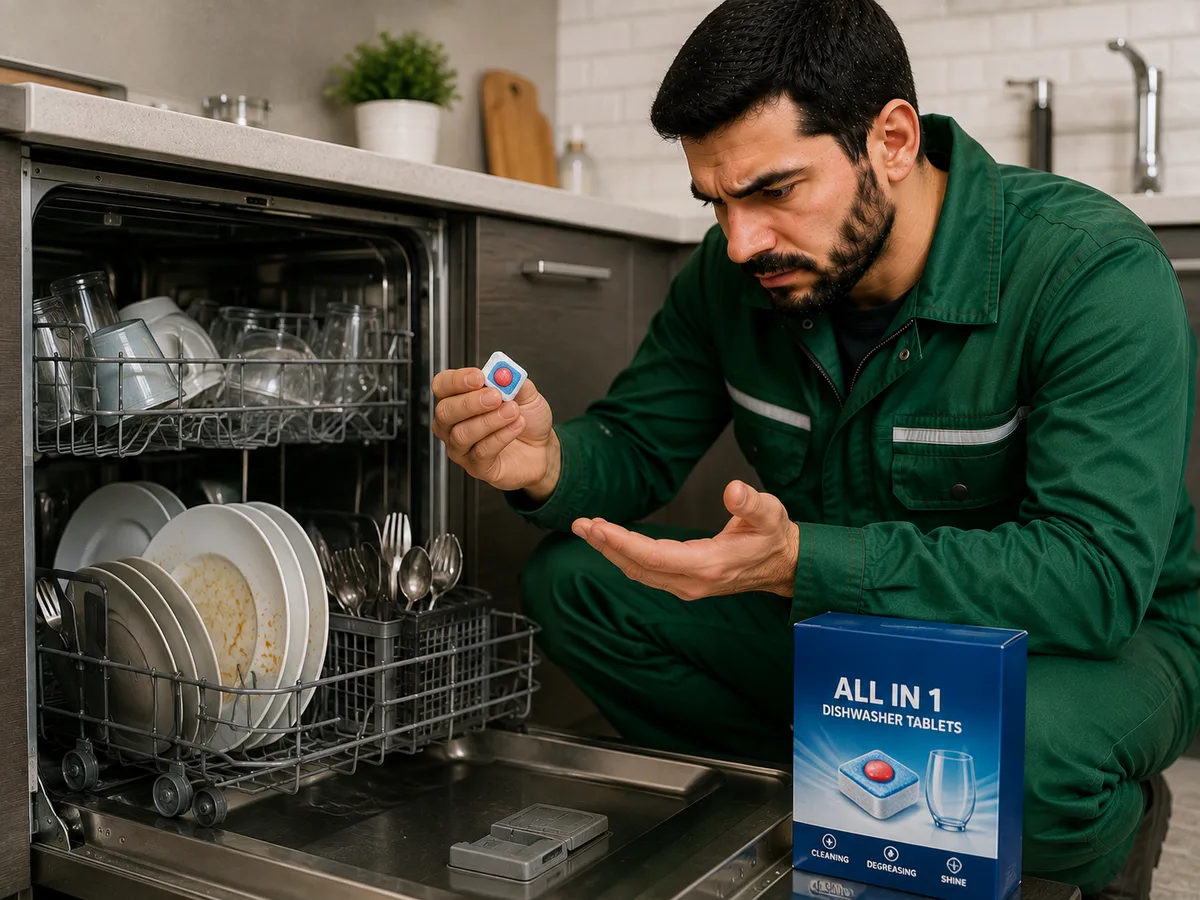
If the dishwasher tablet does not dissolve completely, the washing quality may noticeably decrease. Sometimes the tablet remains inside the detergent dispenser after the program ends, dissolves only partially, or leaves detergent residue on the dishes. The cause is not always the quality of the tablet itself — water temperature, circulation, spray arms, and the detergent dispenser mechanism can also affect the result.
First, check the selected program. Short and low-temperature programs may not provide enough time or heat for the tablet to dissolve completely. This is especially common with large or multifunction dishwasher tablets.
Insufficient water heating is another common cause. If the heating element, temperature sensor, or electronic control system is faulty, the water may not reach the required temperature. If the dishes and the inside of the dishwasher remain completely cold after the program, the heating system should be checked.
The problem may also occur if the detergent dispenser lid does not open properly. If the mechanism is stuck, the lid is damaged, or large dishes prevent it from opening, the tablet may remain inside the dispenser during the wash cycle.
Improper operation of the spray arms can also prevent the tablet from dissolving. If the spray holes are blocked by food particles or limescale, water may not reach the detergent dispenser with sufficient pressure. This can reduce both tablet dissolution and overall washing performance.
A heavily clogged filter can restrict water circulation. When grease and food residue accumulate in the filter, the circulation pump may not move water properly. As a result, less water reaches the tablet and the water pressure decreases.
A weak or faulty circulation pump may also cause this problem. If the pump cannot deliver water to the spray arms with sufficient pressure, the detergent may not dissolve properly and the dishes may not be cleaned effectively.
If the tablet dispenser is wet, some tablets may stick to its surface. It is better to make sure the compartment is dry before inserting the tablet. Moisture can soften the tablet and cause it to stick to the lid or inside of the dispenser.
A tablet that is too large may also become stuck in the dispenser. If it fits too tightly, it may not fall out freely when the lid opens. It is advisable to use a detergent product suitable for the specific dishwasher model.
Overloading the dishwasher can also prevent the tablet from dissolving properly. A large pot, plate, or other item may block the detergent dispenser and prevent water from reaching the tablet. Dishes should be arranged so that the spray arms can rotate freely and the dispenser is not obstructed.
Pay attention to these signs: if the tablet remains in the dispenser after every program, the dishwasher does not heat the water, the spray arms do not rotate, the dishes remain dirty, or the program operates unusually, the circulation and heating systems should be checked.
If the dishwasher tablet does not dissolve, it is recommended to contact a professional dishwasher repair technician. The technician will check the detergent dispenser mechanism, heating element, temperature sensor, filter, spray arms, circulation pump, and electronic control system. Once the exact cause is identified, you will be informed in advance about the required repair work and cost.